News of forthcoming Print Scotland Events will be posted soon.


News of forthcoming Print Scotland Events will be posted soon.

As well as being specialist magazine and booklet printers, Cowan Print are able to offer our customers a complete range of commercial printing and professional design services.
Recent investment in new premises and print machinery means we can provide a 24 hour print service to our customers all over Scotland and the UK. From small to large projects, our skilled team will produce your print to the highest quality on time, every time, whether it be an exclusive, bespoke digital copy or large volume litho

Compass Print Holdings Ltd was established in 1974 and is the largest privately owned print company in the North East of Scotland, employing 29 staff. We have constantly reinvested in cutting edge technology to provide our staff and customers with the best equipment available to produce quality print on time, every time. Our core business is totally customer focused, producing the complete package of management, production and supply of corporate print, signage and exhibition displays.
Our goal is to utilise this state of the art technology in the production of corporate documentation. To partner our clients, sharing experiences to best produce their corporate needs and to provide a product and service that exceeds client expectation.
Our clients tell us they like to work with us because we don’t just do the accepted, expected thing. We put in more effort, we offer more advice, we share our experience and we go the extra mile. On the surface, one printer can seem pretty much like another. But some will always follow while others lead. The way we look at it, a new business card is just as likely to hook your next client as a full colour brochure or exhibition stand. So if we can suggest a technique or a style that will make your project more memorable, we’ll tell you about it. Then you choose the direction you want to take. Distance is no object in this inclusive process, thanks to our efficient online proofing system via the internet. Our portfolio of successful print jobs is extensive. From single colour business cards to the most complex corporate brochure, from safety labels to exhibition displays, we do it all. From the moment we receive a project we take full responsibility for it until satisfactory completion. We ensure the work is perfect – finished, packed and delivered, on time.
For 35 years Compass Print Holdings Ltd has been the leading exponent of quality printing in the North and North East of Scotland. One of the main factors in our success has been our continual investment in the most advanced print technology available, operated by fully trained print professionals. To illustrate our vision, we recently extended our portfolio to include Digital litho and a new Signs and Exhibition division.
Compass Print Holdings Ltd have FPAL accreditation and are willing to participate in feedback reports as a performance enhancement tool.
From the moment you hand over a print or exhibition / signage / display project to us, we take full responsibility for it, and while we are making sure your project is perfect – finished, packed and delivered on time – you can get on with the job of running your business instead of running to stand still.
The name Letts has been synonymous with diaries since the beginning of the nineteenth century. In 1796, the founder, John, established a stationery business in the arcades of London’s Royal Exchange.
The merchants and traders who frequently purchased stationery items from this shop needed a means of recording the movements of stock and controlling their finances. John Letts responded to the needs of his merchant customers in 1812 by creating the world’s first Commercial Diary.
The diary soon established itself as an essential feature of commercial life. The rapid refinement of the product, with the introduction of detailed information sections, meant that by the 1820’s the first modern style diary ranges were published.
Today, the company manufactures over 22 million diaries and is firmly established as the market leader supplying more than 40 per cent of all branded diaries in the UK and exporting to over 75 countries around the world
In the past few years, Letts have invested in machinery and fulfillment systems that allows them to offer a more personalised option. We now implement global contracts, which include a web-based order system, offering bespoke products, and added product personalisation which are then fulfilled to all regions of the world. Over 300 staff are employed by Letts at a 250,000 sq ft factory which incorporates customer service, print, bindery, and fulfillment on one site.
Throughout the years Letts has undergone a number of ownership changes and in August 2000 a Management Buyout team were successful in buying the company. Discussions commenced on October 2000 to acquire Filofax. In July 2001 Letts Holdings Ltd acquired the Filofax Group to become the Letts Filofax Group Ltd. LFG now comprises principally of two UK operations and eight overseas subsidiaries.
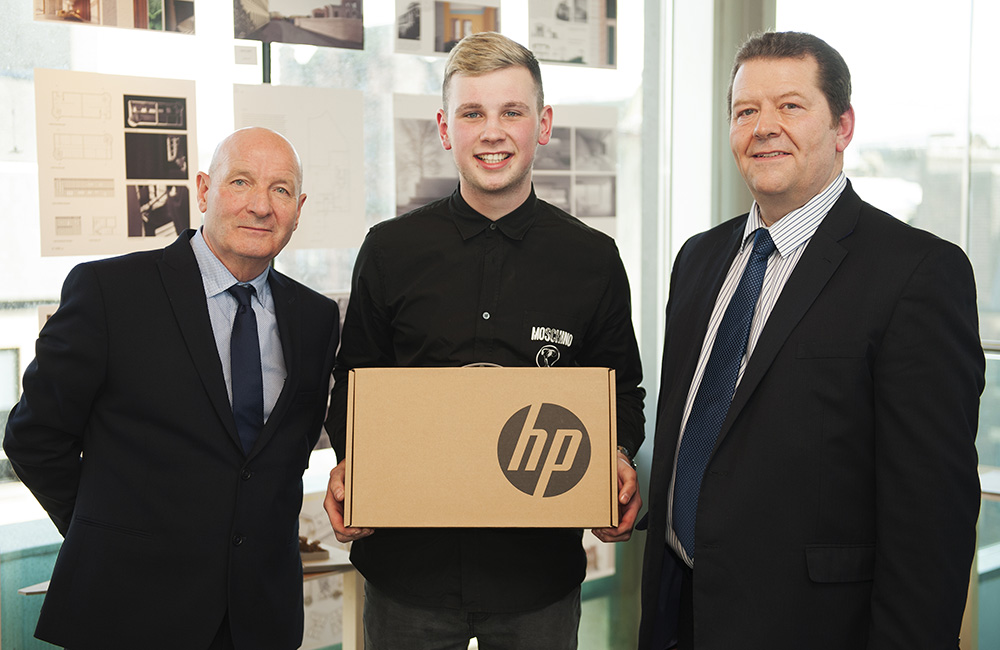
James Vallence, Print Scotland (left) Ross Docherty, 2017 Apprentice of the Year (centre) Garry Richmond, Print Scotland (right)
The trade association, representing Scotland’s graphic communications industry held its second Apprentice Awards on the 21st of April and presented seven award categories, with the overall apprentice of the year named as Post Press / Finishing apprentice Ross Docherty of Bell & Bain Ltd, Glasgow. Print Scotland Director Garry Richmond said Ross won the top prize for “his overall performance, enthusiasm and the hard work he had put in over the past year” Stephen Docherty, the President of Print Scotland and Ross’s father was delighted to present the top prize as a proud father and Managing Director of Bell & Bain Ltd. Sponsoring the awards were HP, who provided tablets as prizes, Antalis and Muller Martini who both provided gift cards and Maclay Murray and Spens one of Scotland’s top legal firms provided sponsorship to the overall event.
Janes Rixon, Business Development Manager, HP Large Format Printing and David McGinlay Muller Martini sales manager for northern Europe both attended and presented prizes. Richmond said:
It was great to see such a fantastic turn out in support of our young apprentices. All the employers whose apprentices were on the shortlist were there. It was a great atmosphere and the employers were delighted that their apprentices were recognised. The apprentices left inspired to be on the winning list for nest year
David McGinlay was an apprentice that came through the Glasgow College of Building and Printing and said he felt it was an honour to take part in such an important event, adding:
The competition for the seven awards was tough this year. It was quite encouraging to see quality of the young people coming through. The industry as a whole has a problem attracting young people but there’s a future in this industry if you just keep your head down and work hard.
Jane Rixon, who is also a Print Scotland non-executive director representing printing technology manufacturing, said:
I thought the awards were very inspiring this year and it was great to see the development of young people within our industry.The day was a celebration of learning within our industry and I was proud to be associated with the apprenticeship scheme and the awards themselves on behalf of HP.
Scottish print apprenticeships are administered by GES and fully provided in the workplace.
Print Scotland Director Garry Richmond is concerned about future skills shortage and said:
Our industry is facing a sustainability issue through the lack of skilled employees for the future. I appreciate that it can be difficult for employers to sometimes think outside of the pressure of current day to day business. However if we do not start thinking 10 years ahead for skilled labour supply and bring on new apprentices we will really struggle to fill the skills gap. I would urge all employers to take on an apprentice wherever possible.
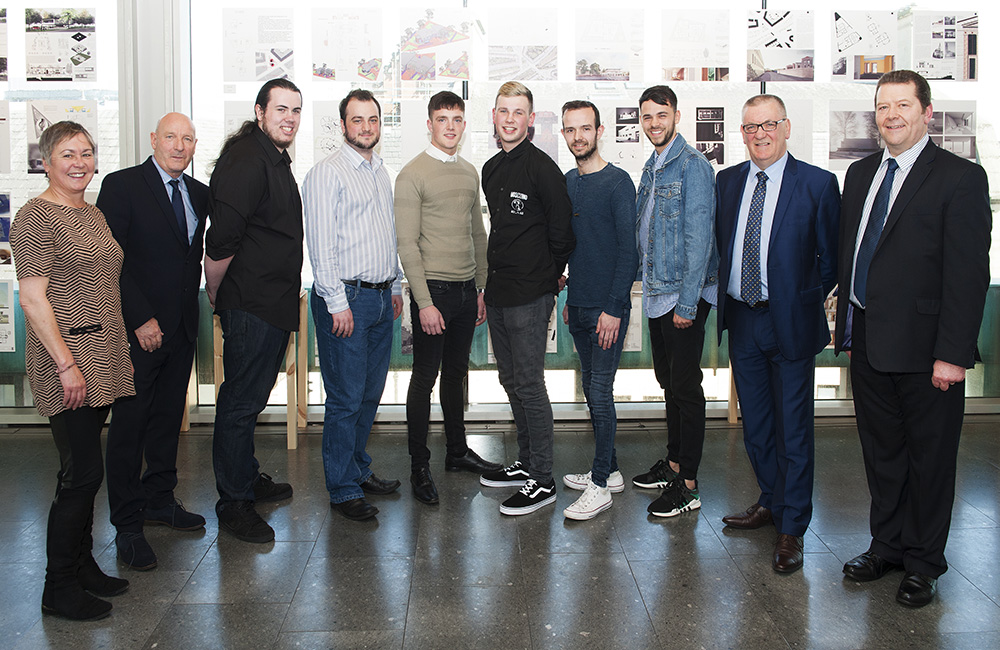
Print Scotland Annual Apprentice Awards 2017, winners
Gordon Smith NSD International Level 2 Pre Press / Digital Print
Hayden Edgar Alba Printers – Level 2 Press / Lithography
Craig Robertson J Thomson Colour Print – Level 2 Post Press / Print Finshing
Ross McGruer NHS – Level 3 Pre Press / Digital Print
Scott Stockman Tradeprint, – Dundee Level 3 Press / Lithography
Sean Gillan Bell & Bain Ltd – Level 3 2 Post Press / Print Finishing
Thank you to our sponsors



Brown Brothers offers you perfection in print. You’ll love our highly personal service, the incredible level of attention we’ll give each of your jobs and the assurance we’ll never let you down. But it’s the outstanding quality of our work which will really blow you away, especially when it comes to colour.
We deliver printing solutions to customers all across the UK and it’s colour where we truly excel. Producing vibrant pieces of print, we guarantee to give you striking results every time and on any kind of stock.
Established over 60 years ago, we operate from our recently expanded and modernised facilities in Ayrshire. Conventional litho is still at the core of our business but we also provide digital printing, as well as a full design and repro service, and specialist print finishing.
We do every type of print job imaginable – from stationery and books, to corporate brochures, folders, packaging and all kinds of marketing and promotional material. Design agencies, private industry and not for profit organisations are just some of our customers who trust us to produce their print with impact and support their success.

To achieve the best for our customers is to know exactly what they want and what they can expect from us. At Bell & Bain, each order from the placing of the initial inquiry to the completion and delivery of the final job is tracked and monitored so that the delivery date that you the customer requires, is achieved. Each member of staff produces a quality product that is documented through our Process and Product Quality Assurance Scheme. At every stage during the production cycle your job can be tracked to the precise stage of manufacture ensuring that the requested target date is being achieved

Antalis is a major international distributor of paper, packaging, and visual communication products across 31 countries.
Antalis is one of Europe’s leading distributors of papers, packaging, and visual communication solutions. The company operates across 31 countries, serving more than 100,000 customers with a network of 120 distribution centres. As a subsidiary of KPP Group Holdings (Japan), Antalis offers extensive e‑commerce solutions and a broad portfolio of sustainable products. Their UK offices provide paper, packaging materials, and graphic communication products for commercial and industrial customers

Alba Printers deliver high quality litho, digital and large format print services to a wide range of organisations and individuals. Alba also provides in-house graphic design, marketing solutions, copywriting and project management services too.
For over 20 years, leading commercial companies, Health Trusts, Universities, artists, photographers, authors and local businesses and organisations, have all benefited from our commitment to deliver our customers’ requirements – on time and on budget.
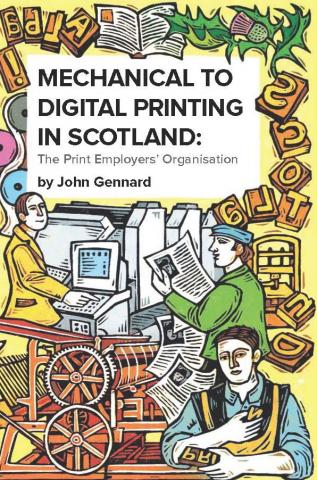 A hundred years ago, twenty three delegates from all over Scotland met in the North British Hotel, Edinburgh, and founded the Scottish Alliance of Masters in Printing and Allied Trades, later known as the Scottish Master Printers Society and the Scottish Print Employers Federation. Now know as Graphic Enterprise Scotland, this book marks the organisation’s centenary by tracing its evolution during a century of technological change in one of Scotland’s most significant industriues.
This book is a culmination of six years work by John Gennard, produced through painstaking analysis of a massive volume of documentation accumulated since 1910, and by face-to-face interviews with significant individuals associated with the organisation.
The story told is a fascinating one, which wends its way through history from the installation of the first printing press in Edinburgh in 1507 to the effects and implications of modern digital printing of today.
Although our organisation was founded only in 1910, John explains in some detail the development of printing in Scotland to that date and the very significant technological changes brought about by the introduction of mechanical typesetting at the end of the nineteenth and early twentieth centuries. He demonstrates clearly how these changes radically affected the economics of printing and the effects on people in print and the development of organised labour.
Indeed, the original reasons for the formation of the Scottish Alliance of Masters in Printing and Kindred Trades on 8th November 1910 are identified as the introduction of mechanical composition through the Linotype and Monotype machines, the growth of the trade union membership and power, the creation of a national federation of print unions and the need to deal with the issue of product market competition based on price-cutting between Scottish Master Printers.
The author takes you carefully through the name changes to the Scottish Alliance of Master Printers 1953, Society of Master Printers of Scotland 1960, the Scottish Print Employers Federation 1990 and to Graphic Enterprise Scotland 2008. At each change he indicates the socio-economic dynamics coming into play and how they are all associated with technological change, organised labour, collective agreements, and government policy and legislation.
One of the significant themes throughout the history is that, despite the name changes, the role of the organisation has changed little. Core services of negotiation of collective agreements with the trade unions, the training of apprentices and political lobbying still remain with us today. The author also outlines technological changes such as direct to plate, direct to press, digital printing and the progressive amalgamation of the trade unions into Unite the union, as a modern day version of the ‘raison d’être’ of the organisation.
A recurring feature of the story is our relationship to other print employers’ organisations, elsewhere in the UK. Scotland had been a founder member of the BFMP but in 1910 formed its own organisation. It progressively developed its autonomy in finance, conditions of membership, its own collective agreements and over the years pulled out of areas of influence at the BFMP, such as representation on the governing council and major sub-committees. It is particularly apt since John explains the ups and downs of a fractious relationship with the BFMP and its successor organisation, not finally settled until 1984.
Membership numbers have also changed in line with the economic changes encountered in our history. Membership was at its peak in the 1950s and 1960s, but since then it has been in decline through liquidations, takeovers and amalgamations. However, as John illustrates, the organisation has always managed to attract new members and he points out that one of the objectives of GES today is to recruit new full and associate members, together with developing new services in line with members’ business requirements. Success to date has been limited and the industry still exhibits the commercial pressures of poor margins, falling demand, a strong pound, overcapacity and downward pressure on pricing. John also adds the new challenges of e-procurement and new media.
John skilfully portrays our history over the past 100 years, chronicling our passage through the growth of printing companies in Scotland, the development of craft unions, the response to organised labour and the impact of technical change on individuals, organisations and labour relations. This work will be of interest to any social historian but, in particular, to anyone with any connection to the printing industry.
The book is a testimony to the scholarship of the author and to the people in the organisation and industry over the past century. We have survived by reacting to changes in printing and the commercial factors within Scotland and the UK.